Understanding the die casting cost per kg is a fundamental requirement for procurement managers and engineers aiming to optimize production budgets in the automotive, aerospace, and consumer electronics sectors. In a global market where material prices fluctuate daily, having a clear grasp of how raw metal costs translate into finished part expenses allows companies to make informed decisions about material selection and supplier negotiation.
Beyond simple raw material pricing, the actual cost per kilogram in die casting is influenced by a complex interplay of tool amortization, energy consumption, and cycle times. While a simple weight-based estimate provides a starting point, the true commercial value lies in understanding the "total cost of ownership," where efficiency in the casting process reduces the overall die casting cost per kg through minimized waste and optimized scrap recovery.
Globally, the shift toward lightweighting—replacing heavy steel components with aluminum or magnesium alloys—has placed a spotlight on the economic viability of these processes. By analyzing the die casting cost per kg, manufacturers can balance the trade-off between high-performance material properties and the financial constraints of mass production, ensuring that innovation does not come at an unsustainable price point.
Global Economic Context of Die Casting Costs
The global landscape of metal casting is currently facing unprecedented volatility due to shifts in raw material supply chains and energy costs. According to industry trends aligned with ISO standards for quality management, the die casting cost per kg is no longer a static figure but a dynamic variable influenced by geopolitical stability and the cost of secondary (recycled) aluminum.
For manufacturers operating across borders, the challenge lies in reconciling the low labor costs of certain regions with the high energy demands of high-pressure die casting (HPDC) machines. This economic tension makes the analysis of cost per kilogram essential for maintaining competitive pricing in highly saturated markets like automotive components and consumer hardware.
Defining the Die Casting Cost per Kg Metric
In simple terms, the die casting cost per kg is a benchmarking metric used to estimate the price of a cast part based on its final weight. It encompasses not only the raw ingot price—such as A380 aluminum or ADC12—but also the operational overhead required to melt, inject, and cool the metal within a precision mold. It serves as a shorthand for efficiency, allowing engineers to quickly estimate if a design is over-engineered or cost-prohibitive.
From a broader industrial perspective, this metric is intrinsically linked to the pursuit of resource efficiency. In an era where humanitarian and environmental needs demand a reduction in carbon footprints, calculating the die casting cost per kg helps companies transition toward "lean manufacturing." By reducing the amount of metal needed per part (thin-wall casting), the cost per unit drops even if the processing cost per kg remains constant.
Furthermore, this definition extends to include the "yield rate"—the ratio of finished parts to the total metal poured. A process with a high scrap rate will effectively increase the die casting cost per kg because the energy and labor spent on defective parts must be absorbed by the successful ones. Therefore, the metric is as much a measure of quality control as it is of financial expenditure.
Core Factors Influencing Casting Expenditure
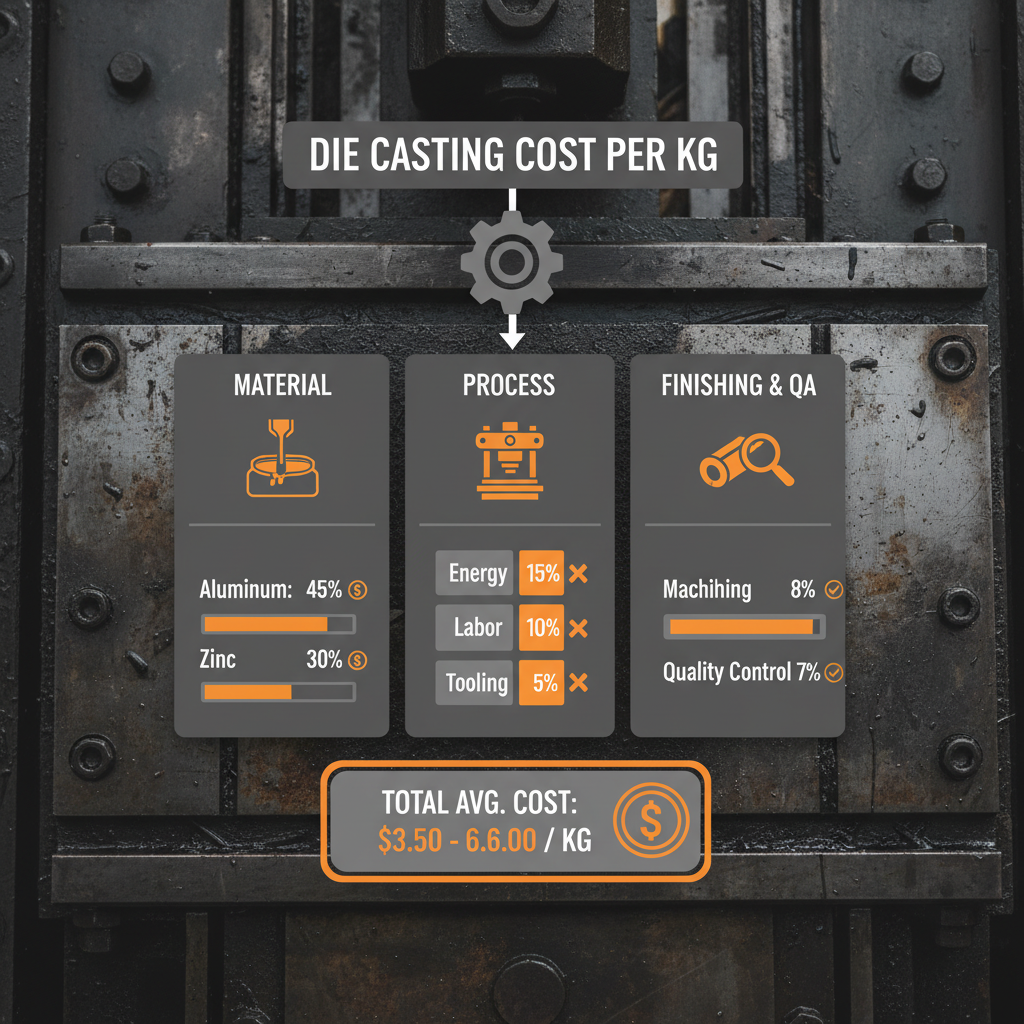
The first major driver of the die casting cost per kg is material purity and alloy selection. Higher-grade alloys with specific additives for corrosion resistance or thermal conductivity naturally command a premium. The volatility of the LME (London Metal Exchange) means that the base cost of aluminum or zinc can shift the per-kilogram price significantly within a single quarter.
Secondly, tooling complexity and scalability play a critical role. While the raw material cost is linear, the cost of the steel die is a fixed investment. For low-volume runs, the amortization of the tool adds a massive "invisible" surcharge to the die casting cost per kg. Conversely, in high-volume automotive production, the tool cost is spread across millions of units, making the raw material and cycle time the dominant cost drivers.
Finally, secondary operations such as CNC machining, surface coating, and deburring significantly impact the final delivered cost. Many clients confuse the raw casting cost per kg with the finished part cost. In precision castings, the "buy-to-fly" ratio—the weight of the raw casting versus the weight of the final machined part—can dramatically inflate the effective die casting cost per kg.
Material Comparison and Cost Efficiency
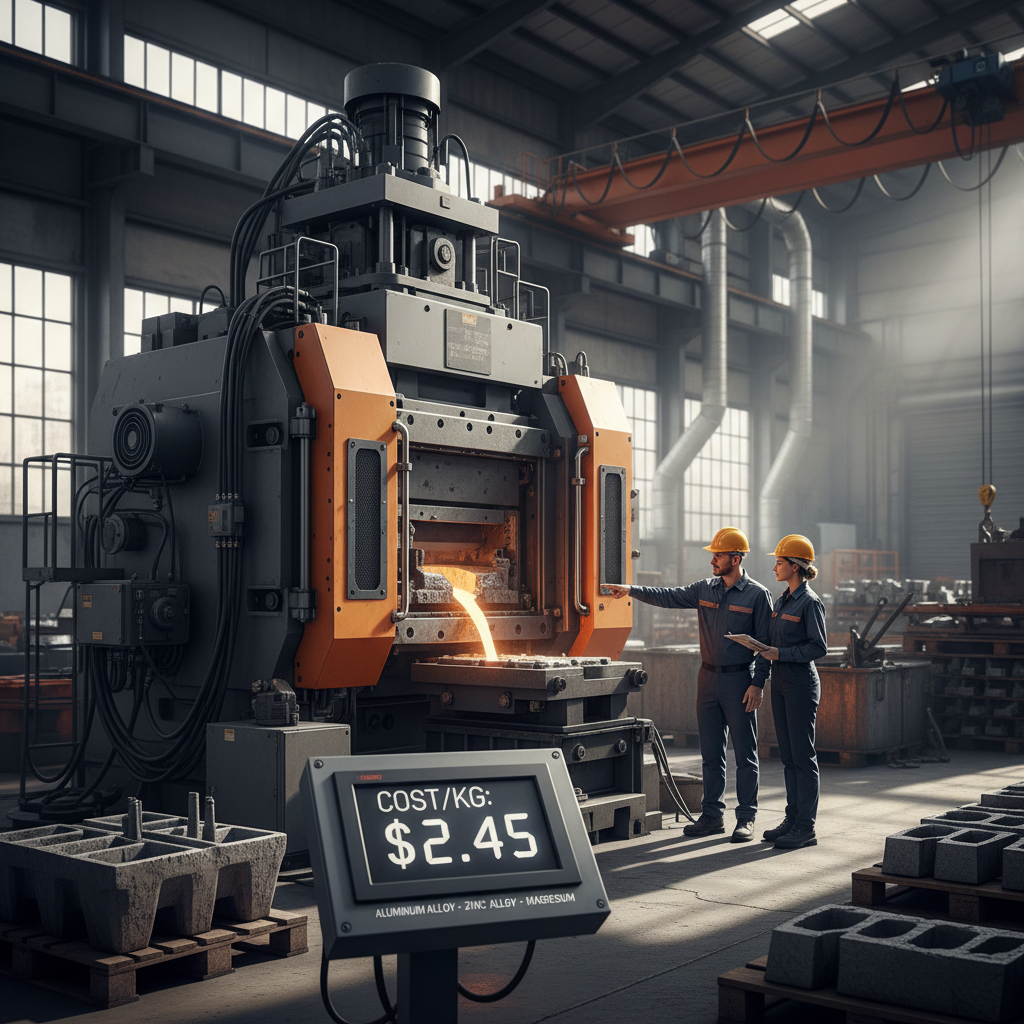
When evaluating different metals, the die casting cost per kg varies wildly based on melting points and mold wear. Aluminum is the industry standard for its balance of weight and cost, whereas Zinc offers superior precision but higher density, which can increase shipping costs and raw material spend per part. Magnesium is the lightest but requires specialized safety equipment due to its combustibility, adding to the operational overhead.
To optimize efficiency, manufacturers often look at the "cost-to-performance" ratio. For instance, while a specific high-strength alloy might increase the die casting cost per kg, it may allow for a thinner wall design, reducing the total weight of the part and ultimately lowering the overall piece price.
Comparison of Die Casting Cost per Kg by Material Type
Global Applications and Industrial Use Cases
In the automotive sector, the die casting cost per kg is a critical KPI for engine block and transmission housing production. In regions like Germany and Japan, where automation is high, the cost per kg is offset by extreme precision and low defect rates. In contrast, emerging industrial zones in Southeast Asia focus on maximizing throughput to lower the per-kg cost for mass-market components.
Another compelling use case is found in the telecommunications industry. The heat sinks and chassis for 5G base stations require a specific blend of thermal conductivity and weight. Here, the die casting cost per kg is analyzed against the cooling efficiency of the part; if a slightly more expensive alloy reduces the need for active cooling (fans), the total system cost decreases despite a higher initial casting price.
Long-Term Value and Sustainability Benefits
Investing in an optimized process to lower the die casting cost per kg provides significant long-term reliability. When a manufacturer masters the balance of pressure and temperature, they reduce internal porosity in the metal. This means the parts are not only cheaper to produce but also more durable, reducing warranty claims and increasing customer trust in the brand.
From a sustainability angle, the use of secondary aluminum can slash the energy required for production by up to 95% compared to primary aluminum. This shift directly lowers the environmental "cost" per kg, aligning the company with global ESG (Environmental, Social, and Governance) goals. It transforms the casting process from a carbon-heavy operation into a circular economy success story.
Ultimately, the logical and emotional value of cost optimization lies in innovation. When companies reduce their die casting cost per kg through smarter engineering, they free up capital to invest in new product lines or improve safety features, ensuring that the final product provides maximum dignity and utility to the end-user.
Future Innovations in Cost Reduction
The future of die casting cost per kg is being reshaped by "Industry 4.0" and digital twin technology. By simulating the casting process in a virtual environment, engineers can predict defects before a single drop of metal is poured. This eliminates the costly trial-and-error phase of mold adjustment, significantly lowering the amortized cost per kilogram for new product launches.
Furthermore, the integration of AI-driven energy management systems allows casting plants to operate during off-peak electricity hours and optimize furnace temperatures in real-time. This reduction in utility expenditure is passed down into the die casting cost per kg, making high-pressure die casting more competitive against traditional sand casting for medium-volume orders.
We are also seeing a trend toward "Giga-casting," where massive components are cast as a single piece rather than assembling dozens of smaller parts. While the initial investment is enormous, the reduction in assembly labor and the optimization of the die casting cost per kg across a massive volume create a disruptive economic advantage.
Analysis of Cost Drivers and Efficiency Gains in Modern Die Casting
| Cost Component |
Impact on Cost per Kg |
Optimization Method |
Efficiency Score (1-10) |
| Raw Alloy Ingot |
Very High |
Recycled Material Sourcing |
9 |
| Energy/Electricity |
High |
Induction Furnace Upgrades |
7 |
| Tooling Amortization |
Medium |
High-Volume Production Runs |
8 |
| Labor & Finishing |
Medium |
Robotic De-burring Arms |
6 |
| Scrap Rate/Waste |
High |
Real-time Process Monitoring |
8 |
| Logistics/Shipping |
Low |
Localized Sourcing Hubs |
5 |
FAQS
For complex parts, the cost is not a simple multiplication of weight and material price. It involves calculating the "shot weight" (total metal injected), subtracting the scrap/runner weight, and adding the allocated cost of the die and machine time. Therefore, complex parts with high runner-to-part ratios often have a higher effective die casting cost per kg than simple blocks.
Yes, significantly. Aluminum is generally more cost-effective for large parts, while Zinc, though more expensive per kg, allows for much thinner walls and higher precision, which can reduce the total material needed. Magnesium is often the most expensive to process due to the specialized atmosphere required to prevent oxidation and combustion during casting.
Absolutely. Implementing "Design for Manufacturing" (DfM) principles—such as optimizing wall thickness, reducing the number of cores, and streamlining the gating system—can lower the cycle time and scrap rate. This efficiency reduces the operational overhead allocated to each kilogram of metal, effectively lowering the cost per kg.
Production volume has an inverse relationship with the cost. Because the initial cost of the die (tooling) is a fixed expense, producing 100,000 parts spreads that cost much thinner than producing 1,000 parts. In high-volume scenarios, the die casting cost per kg approaches the raw material and energy cost, whereas low-volume parts are dominated by tooling amortization.
Generally, yes. Secondary aluminum requires significantly less energy to process than extracting primary aluminum from bauxite ore. However, the "cost" is a balance of price and purity. For critical aerospace components, the higher cost of primary aluminum is necessary to ensure structural integrity, whereas for consumer electronics, recycled alloys are a cost-effective and sustainable choice.
CNC machining adds a "value-added" cost that is often calculated separately but affects the total expenditure. If a part requires heavy machining, you are paying for the die casting cost per kg of the material you eventually remove as chips. This is why "near-net-shape" casting is the goal—to minimize waste and keep the effective cost per kg as low as possible.
Conclusion
Mastering the nuances of the die casting cost per kg is essential for any organization looking to scale its manufacturing capabilities without sacrificing quality. We have explored how this metric is influenced by raw material volatility, tooling investments, and the critical shift toward sustainable, recycled alloys. By viewing the cost per kilogram not as a fixed price but as a result of process efficiency and design optimization, companies can achieve a superior balance between performance and budget.
Looking ahead, the integration of AI and Giga-casting will likely drive the die casting cost per kg to new lows, enabling the creation of more complex, lightweight structures that were previously economically impossible. For businesses aiming to remain competitive, the recommendation is to prioritize DfM (Design for Manufacturing) and partner with suppliers who utilize Industry 4.0 technologies. Visit our website for expert sourcing and precision casting solutions: www.hairunsourcing.com